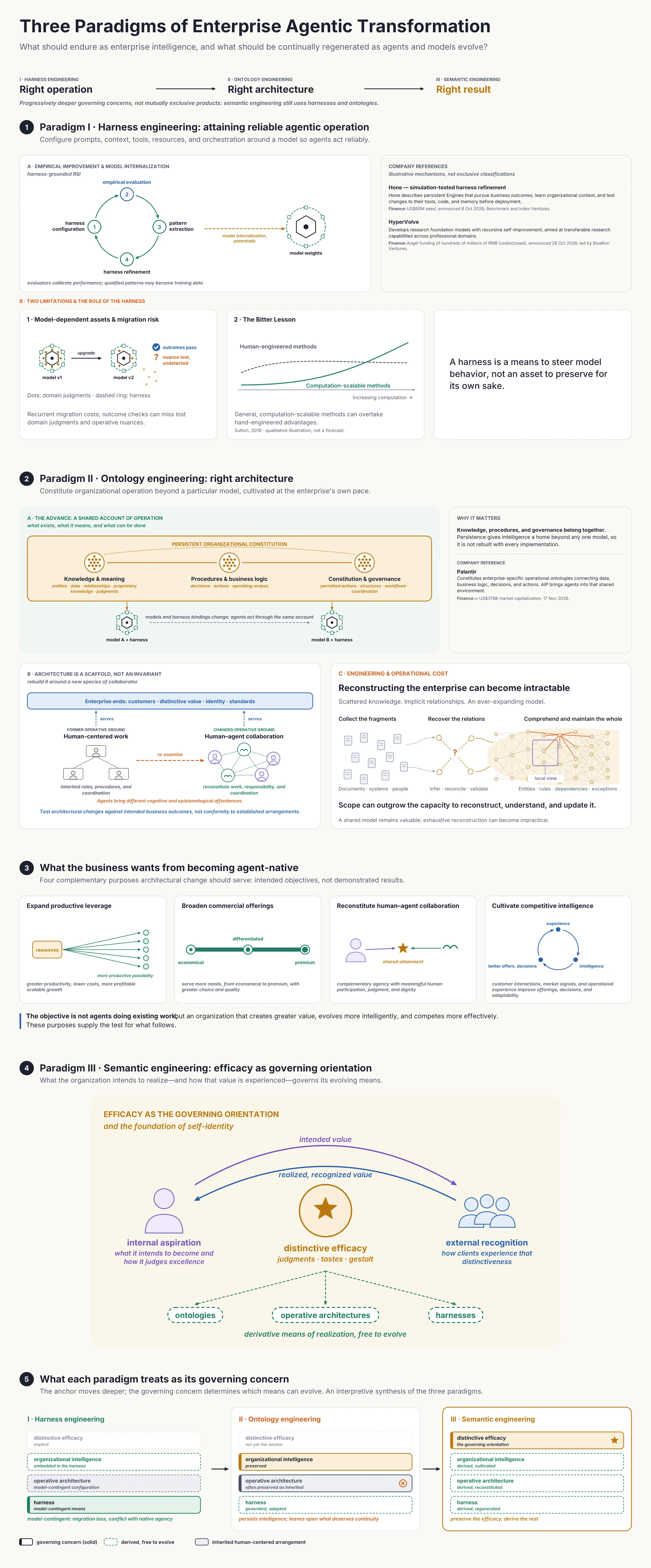
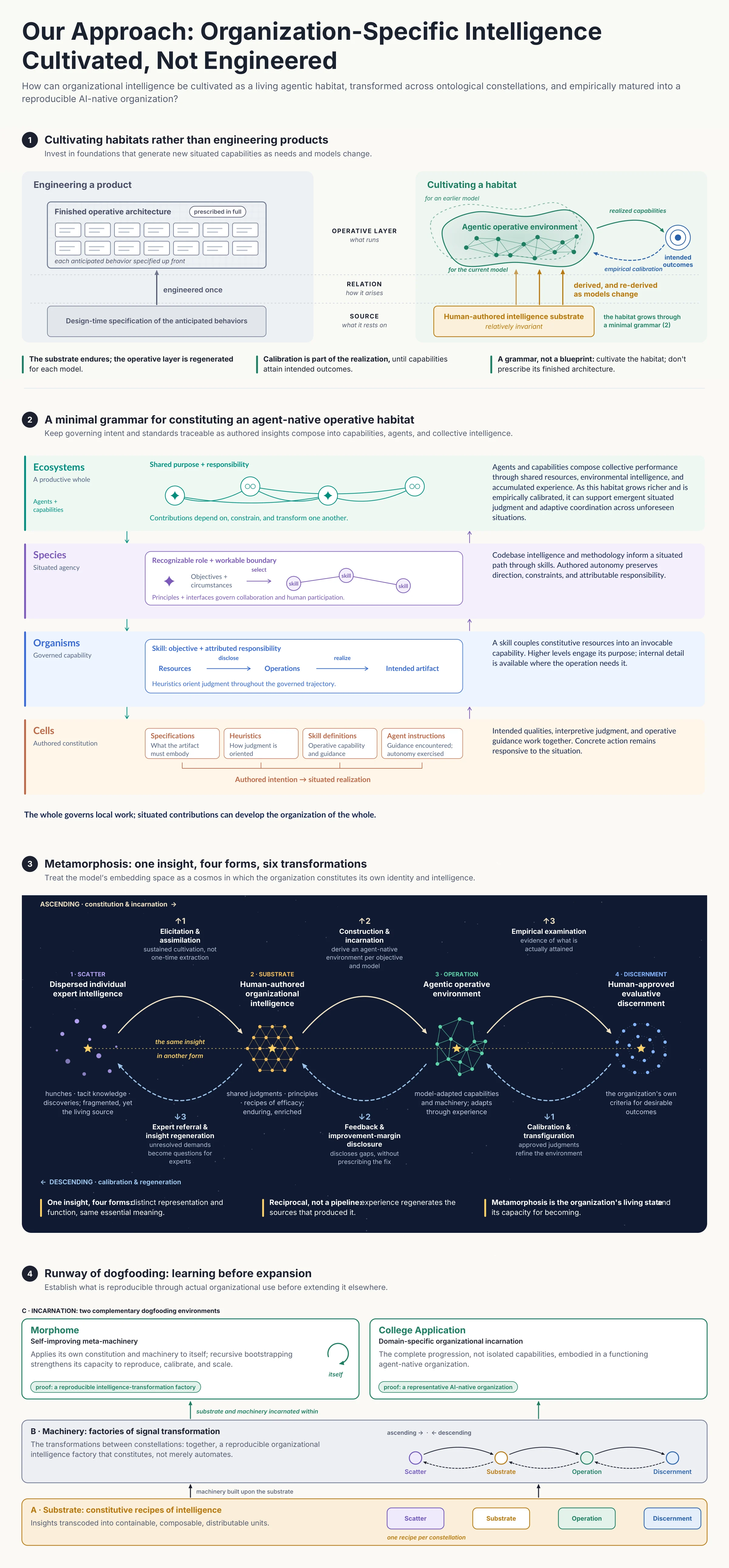
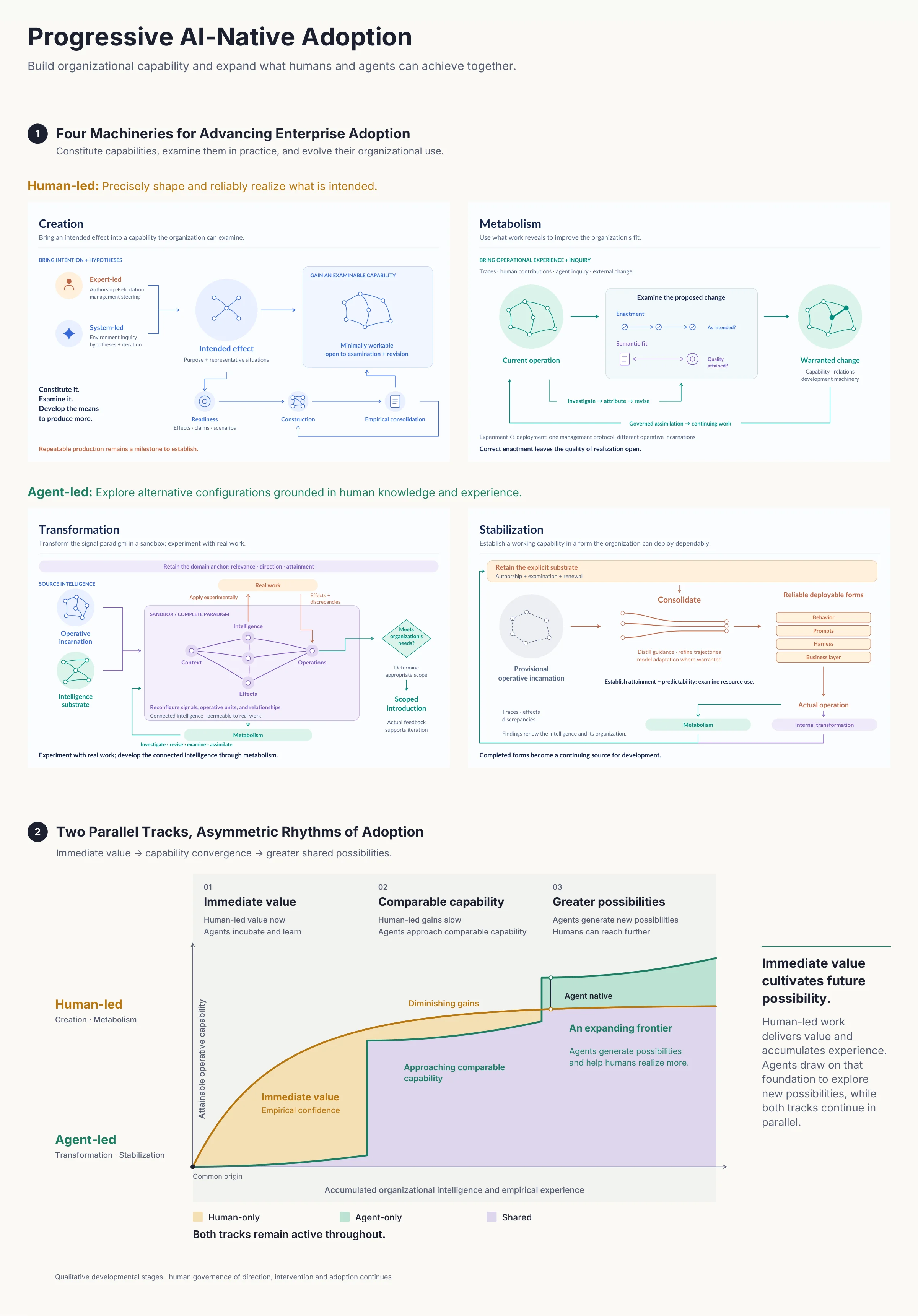
Three Paradigms of Enterprise Agentic Transformation What should endure as enterprise intelligence, and what should be continually regenerated as agents and models evolve? I · HARNESS ENGINEERING Right operation II · ONTOLOGY ENGINEERING Right architecture III · SEMANTIC ENGINEERING Right result Progressively deeper governing concerns, not mutually exclusive products: semantic engineering still uses harnesses and ontologies. 1 Paradigm I · Harness engineering: attaining reliable agentic operation Configure prompts, context, tools, resources, and orchestration around a model so agents act reliably. A · EMPIRICAL IMPROVEMENT & MODEL INTERNALIZATION harness-grounded RSI 1 harness configuration 2 empirical evaluation 3 pattern extraction 4 harness refinement model weights model internalization, potentially evaluators calibrate performance; qualified patterns may become training data COMPANY REFERENCES illustrative mechanisms, not exclusive classifications Hone — simulation-tested harness refinement Hone describes persistent Engines that pursue business outcomes, learn organizational context, and test changes to their tools, code, and memory before deployment. Finance: US$60M seed, announced 8 Oct 2026; Benchmark and Index Ventures. HyperVolve Develops research foundation models with recursive self-improvement, aimed at transferable research capabilities across professional domains. Finance: Angel funding of hundreds of millions of RMB (undisclosed), announced 28 Oct 2026; led by BlueRun Ventures. B · TWO LIMITATIONS & THE ROLE OF THE HARNESS 2 Paradigm II · Ontology engineering: right architecture Constitute organizational operation beyond a particular model, cultivated at the enterprise's own pace. A · THE ADVANCE: A SHARED ACCOUNT OF OPERATION what exists, what it means, and what can be done PERSISTENT ORGANIZATIONAL CONSTITUTION Knowledge & meaning entities · data · relationships · proprietary knowledge · judgments Procedures & business logic decisions · actions · operating recipes Constitution & governance permitted actions · structures · workflows · coordination model A + harness model B + harness models and harness bindings change; agents act through the same account WHY IT MATTERS Knowledge, procedures, and governance belong together. Persistence gives intelligence a home beyond any one model, so it is not rebuilt with every implementation. COMPANY REFERENCE Palantir Constitutes enterprise-specific operational ontologies connecting data, business logic, decisions, and actions. AIP brings agents into that shared environment. Finance: ≈ US$378B market capitalization, 17 Nov 2026. B · ARCHITECTURE IS A SCAFFOLD, NOT AN INVARIANT rebuild it around a new species of collaborator Enterprise ends: customers · distinctive value · identity · standards serves serves FORMER OPERATIVE GROUND Human-centered work inherited roles, procedures, and coordination CHANGED OPERATIVE GROUND Human–agent collaboration reconstitute work, responsibility, and coordination re-examine Agents bring different cognitive and epistemological affordances. Test architectural changes against intended business outcomes, not conformity to established arrangements. C · ENGINEERING & OPERATIONAL COST Reconstructing the enterprise can become intractable Scattered knowledge. Implicit relationships. An ever-expanding model. Collect the fragments Recover the relations Comprehend and maintain the whole Documents · systems · people ? Infer · reconcile · validate local view Entities · rules · dependencies · exceptions Scope can outgrow the capacity to reconstruct, understand, and update it. A shared model remains valuable; exhaustive reconstruction can become impractical. 3 What the business wants from becoming agent-native Four complementary purposes architectural change should serve: intended objectives, not demonstrated results. Expand productive leverage resources more productive possibility greater productivity, lower costs, more profitable scalable growth Broaden commercial offerings economical differentiated premium serve more needs, from economical to premium, with greater choice and quality Reconstitute human–agent collaboration shared attainment complementary agency with meaningful human participation, judgment, and dignity Cultivate competitive intelligence experience intelligence better offers, decisions customer interactions, market signals, and operational experience improve offerings, decisions, and adaptability The objective is not agents doing existing work, but an organization that creates greater value, evolves more intelligently, and competes more effectively. These purposes supply the test for what follows. 4 Paradigm III · Semantic engineering: efficacy as governing orientation What the organization intends to realize—and how that value is experienced—governs its evolving means. EFFICACY AS THE GOVERNING ORIENTATION and the foundation of self-identity distinctive efficacy judgments · tastes · gestalt internal aspiration what it intends to become and how it judges excellence external recognition how clients experience that distinctiveness intended value realized, recognized value ontologies operative architectures harnesses derivative means of realization, free to evolve 5 What each paradigm treats as its governing concern The anchor moves deeper; the governing concern determines which means can evolve. An interpretive synthesis of the three paradigms. I · Harness engineering distinctive efficacy implicit organizational intelligence embedded in the harness operative architecture model-contingent configuration harness model-contingent means model-contingent: migration loss, conflict with native agency II · Ontology engineering distinctive efficacy not yet the anchor organizational intelligence preserved operative architecture often preserved as inherited harness generated, adapted persists intelligence; leaves open what deserves continuity III · Semantic engineering distinctive efficacy the governing orientation organizational intelligence derived, cultivated operative architecture derived, reconstituted harness derived, regenerated preserve the efficacy; derive the rest governing concern (solid) derived, free to evolve inherited human-centered arrangement 1 · Model-dependent assets & migration risk model v1 upgrade model v2 outcomes pass ? nuance lost, undetected Dots: domain judgments · dashed ring: harness Recurrent migration costs; outcome checks can miss lost domain judgments and operative nuances. 2 · The Bitter Lesson Human-engineered methods Computation-scalable methods Increasing computation → General, computation-scalable methods can overtake hand-engineered advantages. Sutton, 2019 · qualitative illustration, not a forecast. A harness is a means to steer model behavior, not an asset to preserve for its own sake.Our Approach: Organization-Specific Intelligence Cultivated, Not Engineered How can organizational intelligence be cultivated as a living agentic habitat, transformed across ontological constellations, and empirically matured into a reproducible AI-native organization? 1 Cultivating habitats rather than engineering products Invest in foundations that generate new situated capabilities as needs and models change. Engineering a product Cultivating a habitat OPERATIVE LAYER what runs RELATION how it arises SOURCE what it rests on Finished operative architecture prescribed in full each anticipated behavior specified up front engineered once Design-time specification of the anticipated behaviors Agentic operative environment for an earlier model for the current model intended outcomes realized capabilities empirical calibration derived, and re-derived as models change Human-authored intelligence substrate relatively invariant the habitat grows through a minimal grammar (2) The substrate endures; the operative layer is regenerated for each model. Calibration is part of the realization, until capabilities attain intended outcomes. A grammar, not a blueprint: cultivate the habitat; don't prescribe its finished architecture. 2 A minimal grammar for constituting an agent-native operative habitat Keep governing intent and standards traceable as authored insights compose into capabilities, agents, and collective intelligence. Ecosystems A productive whole Species Situated agency Organisms Governed capability Cells Authored constitution Shared purpose + responsibility Agents + capabilities Contributions depend on, constrain, and transform one another. Agents and capabilities compose collective performance through shared resources, environmental intelligence, and accumulated experience. As this habitat grows richer and is empirically calibrated, it can support emergent situated judgment and adaptive coordination across unforeseen situations. Recognizable role + workable boundary Objectives + circumstances select skill skill skill Principles + interfaces govern collaboration and human participation. Codebase intelligence and methodology inform a situated path through skills. Authored autonomy preserves direction, constraints, and attributable responsibility. Skill: objective + attributed responsibility Resources Operations Intended artifact disclose realize Heuristics orient judgment throughout the governed trajectory. A skill couples constitutive resources into an invocable capability. Higher levels engage its purpose; internal detail is available where the operation needs it. Specifications What the artifact must embody Heuristics How judgment is oriented Skill definitions Operative capability and guidance Agent instructions Guidance encountered; autonomy exercised Authored intention → situated realization Intended qualities, interpretive judgment, and operative guidance work together. Concrete action remains responsive to the situation. The whole governs local work; situated contributions can develop the organization of the whole. 3 Metamorphosis: one insight, four forms, six transformations Treat the model’s embedding space as a cosmos in which the organization constitutes its own identity and intelligence. ASCENDING · constitution & incarnation → the same insight in another form 1 · SCATTER Dispersed individual expert intelligence hunches · tacit knowledge · discoveries; fragmented, yet the living source 2 · SUBSTRATE Human-authored organizational intelligence shared judgments · principles · recipes of efficacy; enduring, enriched 3 · OPERATION Agentic operative environment model-adapted capabilities and machinery; adapts through experience 4 · DISCERNMENT Human-approved evaluative discernment the organization's own criteria for desirable outcomes ↑1 Elicitation & assimilation sustained cultivation, not one-time extraction ↓3 Expert referral & insight regeneration unresolved demands become questions for experts ↑2 Construction & incarnation derive an agent-native environment per objective and model ↓2 Feedback & improvement-margin disclosure discloses gaps, without prescribing the fix ↑3 Empirical examination evidence of what is actually attained ↓1 Calibration & transfiguration approved judgments refine the environment ← DESCENDING · calibration & regeneration One insight, four forms: distinct representation and function, same essential meaning. Reciprocal, not a pipeline: experience regenerates the sources that produced it. Metamorphosis is the organization's living state and its capacity for becoming. 4 Runway of dogfooding: learning before expansion Establish what is reproducible through actual organizational use before extending it elsewhere. C · INCARNATION: two complementary dogfooding environments Morphome Self-improving meta-machinery Applies its own constitution and machinery to itself; recursive bootstrapping strengthens its capacity to reproduce, calibrate, and scale. proof: a reproducible intelligence-transformation factory itself College Application Domain-specific organizational incarnation The complete progression, not isolated capabilities, embodied in a functioning agent-native organization. proof: a representative AI-native organization B · Machinery: factories of signal transformation The transformations between constellations: together, a reproducible organizational intelligence factory that constitutes, not merely automates. A · Substrate: constitutive recipes of intelligence Insights transcoded into containable, composable, distributable units. Scatter Scatter Substrate Substrate Operation Operation Discernment Discernment ascending → · ← descending one recipe per constellation machinery built upon the substrate substrate and machinery incarnated withinProgressive AI-Native Adoption Build organizational capability and expand what humans and agents can achieve together. 1 Four Machineries for Advancing Enterprise Adoption Constitute capabilities, examine them in practice, and evolve their organizational use. Human-led: Precisely shape and reliably realize what is intended. Creation Bring an intended effect into a capability the organization can examine. BRING INTENTION + HYPOTHESES Expert-led Authorship + elicitation management steering System-led Environment inquiry hypotheses + iteration Intended effect Purpose + representative situations GAIN AN EXAMINABLE CAPABILITY Minimally workable open to examination + revision Readiness Effects · claims · scenarios Construction Empirical consolidation Constitute it. Examine it. Develop the means to produce more. Repeatable production remains a milestone to establish. Metabolism Use what work reveals to improve the organization’s fit. BRING OPERATIONAL EXPERIENCE + INQUIRY Traces · human contributions · agent inquiry · external change Current operation Examine the proposed change Enactment As intended? Semantic fit Quality attained? Warranted change Capability · relations development machinery Investigate → attribute → revise Governed assimilation → continuing work Experiment ↔ deployment: one management protocol, different operative incarnations Correct enactment leaves the quality of realization open. Agent-led: Explore alternative configurations grounded in human knowledge and experience. Transformation Transform the signal paradigm in a sandbox; experiment with real work. Retain the domain anchor: relevance · direction · attainment SOURCE INTELLIGENCE Operative incarnation Intelligence substrate SANDBOX / COMPLETE PARADIGM Context Intelligence Operations Effects Reconfigure signals, operative units, and relationships Connected intelligence · permeable to real work Real work Apply experimentally Effects + discrepancies Metabolism Investigate · revise · examine · assimilate Meets organization’s needs? Determine appropriate scope Scoped introduction Actual feedback supports iteration Experiment with real work; develop the connected intelligence through metabolism. Stabilization Establish a working capability in a form the organization can deploy dependably. Retain the explicit substrate Authorship + examination + renewal Provisional operative incarnation Consolidate Distill guidance · refine trajectories model adaptation where warranted Behavior Prompts Harness Business layer Reliable deployable forms Establish attainment + predictability; examine resource use. Actual operation Metabolism Internal transformation Traces · effects discrepancies Findings renew the intelligence and its organization. Completed forms become a continuing source for development. Two Parallel Tracks, Asymmetric Rhythms of Adoption Immediate value → capability convergence → greater shared possibilities. 2 01 Immediate value Human-led value now Agents incubate and learn 02 Comparable capability Human-led gains slow Agents approach comparable capability 03 Greater possibilities Agents generate new possibilities Humans can reach further Human-led Creation · Metabolism Immediate value Empirical confidence Diminishing gains Approaching comparable capability An expanding frontier Agents generate possibilities and help humans realize more. Agent native Attainable operative capability Immediate value cultivates future possibility. Human-led work delivers value and accumulates experience. Agents draw on that foundation to explore new possibilities, while both tracks continue in parallel. Agent-led Transformation · Stabilization Accumulated organizational intelligence and empirical experience Common origin Human-only Agent-only Shared Both tracks remain active throughout. Qualitative developmental stages · human governance of direction, intervention and adoption continues