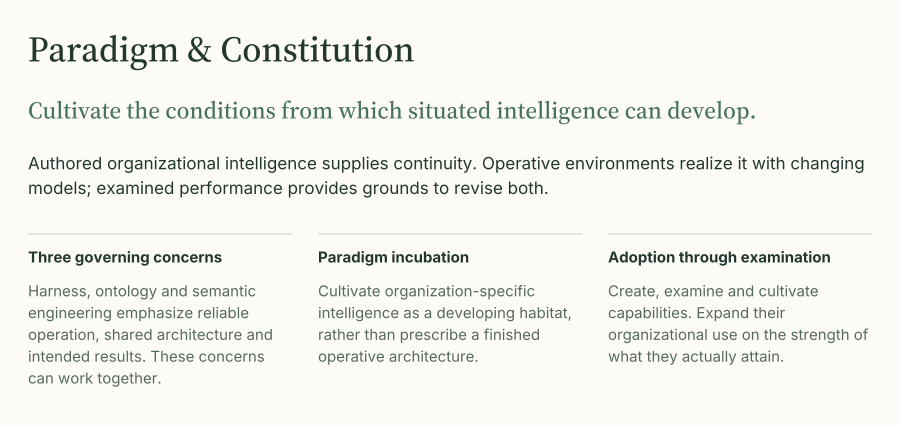
Paradigm & Constitution
Preserving the organization’s architecture can preserve the wrong invariant. Distinctive efficacy—what the organization seeks to realize and how it judges value—governs. Ontologies, operative architectures and harnesses remain derivative, revisable means, not the ultimate assets to defend.
Paradigm & Constitution
Preserving the organization’s architecture can preserve the wrong invariant.
What deserves continuity when the means change?
Harness engineering
Makes operation reliable
Model-contingent: migration can lose subtle judgment.
Ontology engineering
Preserves shared intelligence
But inherited workflows may be the wrong invariant.
Semantic engineering
Governs distinctive efficacy
Derive the architecture from intended value—not vice versa.
Complementary concerns; different answers to what governs the rest.
Distinctive efficacy
Intended value + expert judgment, taste and standards
Derive and regenerate as models and circumstances change
Ontologies · operative architectures · harnesses
Realizations to examine, not structures to freeze
Results test the judgments
Preserve what makes outcomes worth attaining—not the human-era workflow that once delivered them.
Experiment with a new paradigm before replacing the old.
Bounded creation
Examined results
Judgment
Warranted expansion
Hold / redirect
Human-led work can keep delivering while an AI-led track explores a different operative paradigm.
Confidence is evidence for adoption—not authority to adopt.