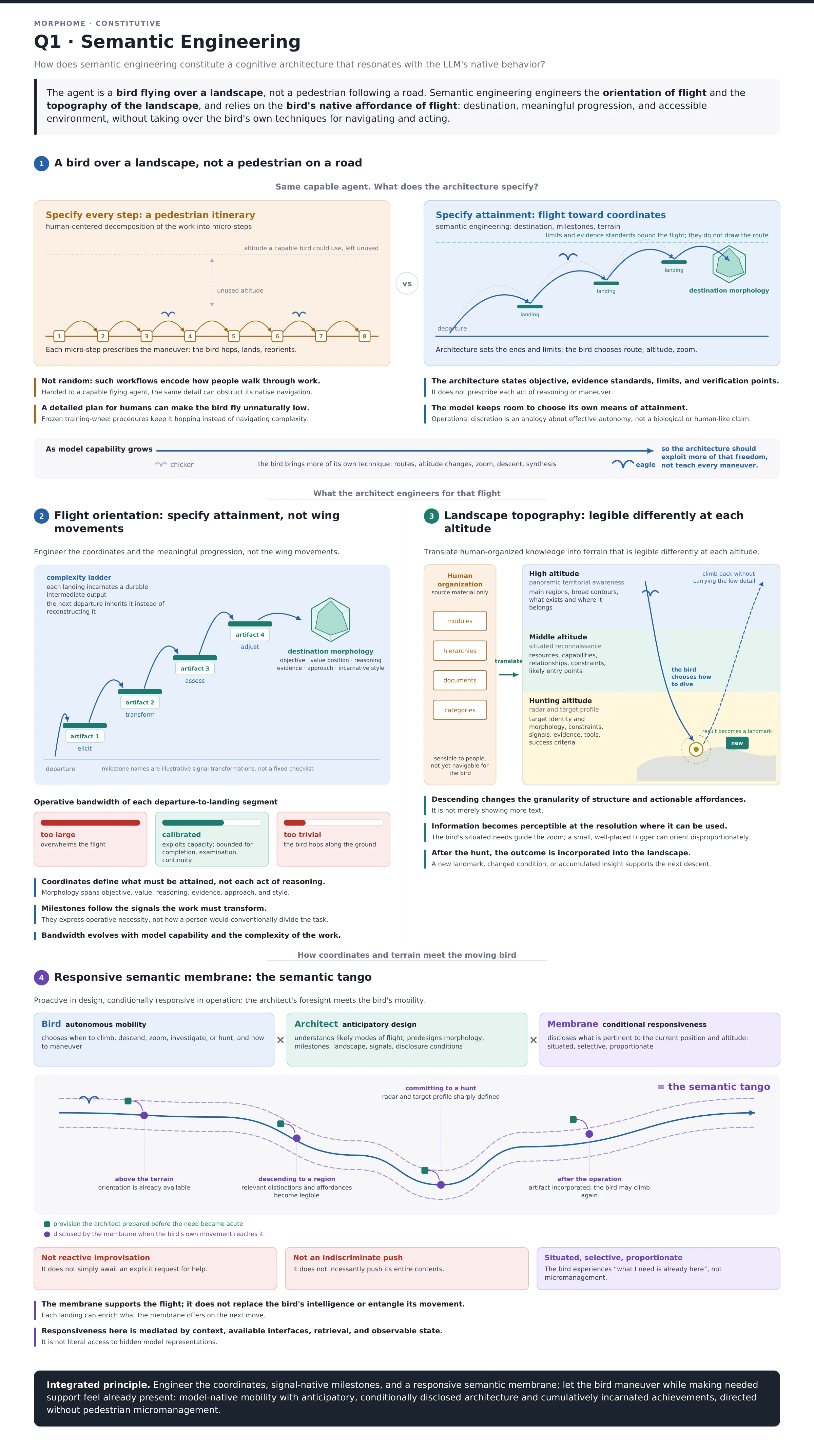
MORPHOME · CONSTITUTIVE Q1 · Semantic Engineering How does semantic engineering constitute a cognitive architecture that resonates with the LLM's native behavior? The agent is a bird flying over a landscape, not a pedestrian following a road. Semantic engineering engineers the orientation of flight and the topography of the landscape, and relies on the bird's native affordance of flight: destination, meaningful progression, and accessible environment, without taking over the bird's own techniques for navigating and acting. 1 A bird over a landscape, not a pedestrian on a road Same capable agent. What does the architecture specify? vs Specify every step: a pedestrian itinerary human-centered decomposition of the work into micro-steps altitude a capable bird could use, left unused 1 2 3 4 5 6 7 8 unused altitude Each micro-step prescribes the maneuver: the bird hops, lands, reorients. Specify attainment: flight toward coordinates semantic engineering: destination, milestones, terrain destination morphology departure limits and evidence standards bound the flight; they do not draw the route Architecture sets the ends and limits; the bird chooses route, altitude, zoom. landing landing landing Not random: such workflows encode how people walk through work. Handed to a capable flying agent, the same detail can obstruct its native navigation. A detailed plan for humans can make the bird fly unnaturally low. Frozen training-wheel procedures keep it hopping instead of navigating complexity. The architecture states objective, evidence standards, limits, and verification points. It does not prescribe each act of reasoning or maneuver. The model keeps room to choose its own means of attainment. Operational discretion is an analogy about effective autonomy, not a biological or human-like claim. As model capability grows chicken eagle the bird brings more of its own technique: routes, altitude changes, zoom, descent, synthesis so the architecture should exploit more of that freedom, not teach every maneuver. What the architect engineers for that flight 2 Flight orientation: specify attainment, not wing movements Engineer the coordinates and the meaningful progression, not the wing movements. departure artifact 1 elicit artifact 2 transform artifact 3 assess artifact 4 adjust destination morphology objective · value position · reasoning evidence · approach · incarnative style complexity ladder each landing incarnates a durable intermediate output the next departure inherits it instead of reconstructing it milestone names are illustrative signal transformations, not a fixed checklist Operative bandwidth of each departure-to-landing segment too large overwhelms the flight calibrated exploits capacity; bounded for completion, examination, continuity too trivial the bird hops along the ground Coordinates define what must be attained, not each act of reasoning. Morphology spans objective, value, reasoning, evidence, approach, and style. Milestones follow the signals the work must transform. They express operative necessity, not how a person would conventionally divide the task. Bandwidth evolves with model capability and the complexity of the work. 3 Landscape topography: legible differently at each altitude Translate human-organized knowledge into terrain that is legible differently at each altitude. Human organization source material only modules hierarchies documents categories sensible to people, not yet navigable for the bird translate High altitude panoramic territorial awareness main regions, broad contours, what exists and where it belongs Middle altitude situated reconnaissance resources, capabilities, relationships, constraints, likely entry points Hunting altitude radar and target profile target identity and morphology, constraints, signals, evidence, tools, success criteria new result becomes a landmark climb back without carrying the low detail the bird chooses how to dive Descending changes the granularity of structure and actionable affordances. It is not merely showing more text. Information becomes perceptible at the resolution where it can be used. The bird's situated needs guide the zoom; a small, well-placed trigger can orient disproportionately. After the hunt, the outcome is incorporated into the landscape. A new landmark, changed condition, or accumulated insight supports the next descent. How coordinates and terrain meet the moving bird 4 Responsive semantic membrane: the semantic tango Proactive in design, conditionally responsive in operation: the architect's foresight meets the bird's mobility. Bird autonomous mobility chooses when to climb, descend, zoom, investigate, or hunt, and how to maneuver × Architect anticipatory design understands likely modes of flight; predesigns morphology, milestones, landscape, signals, disclosure conditions × Membrane conditional responsiveness discloses what is pertinent to the current position and altitude: situated, selective, proportionate = the semantic tango above the terrain orientation is already available descending to a region relevant distinctions and affordances become legible committing to a hunt radar and target profile sharply defined after the operation artifact incorporated; the bird may climb again provision the architect prepared before the need became acute disclosed by the membrane when the bird's own movement reaches it Not reactive improvisation It does not simply await an explicit request for help. Not an indiscriminate push It does not incessantly push its entire contents. Situated, selective, proportionate The bird experiences “what I need is already here”, not micromanagement. The membrane supports the flight; it does not replace the bird's intelligence or entangle its movement. Each landing can enrich what the membrane offers on the next move. Responsiveness here is mediated by context, available interfaces, retrieval, and observable state. It is not literal access to hidden model representations. Integrated principle. Engineer the coordinates, signal-native milestones, and a responsive semantic membrane; let the bird maneuver while making needed support feel already present: model-native mobility with anticipatory, conditionally disclosed architecture and cumulatively incarnated achievements, directed without pedestrian micromanagement.
此页暂无中文版,以下为英文原文。
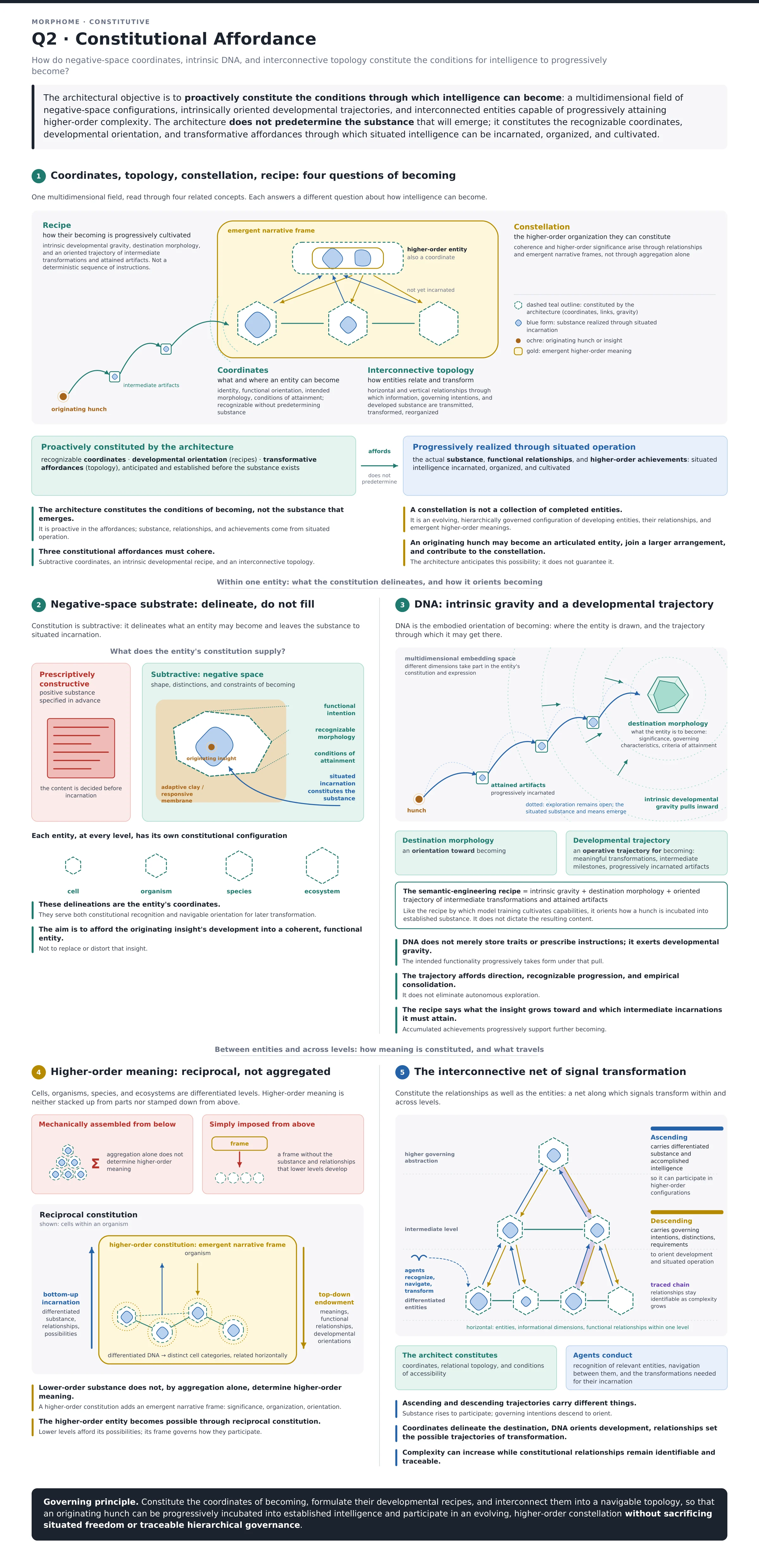
MORPHOME · CONSTITUTIVE Q2 · Constitutional Affordance How do negative-space coordinates, intrinsic DNA, and interconnective topology constitute the conditions for intelligence to progressively become? The architectural objective is to proactively constitute the conditions through which intelligence can become: a multidimensional field of negative-space configurations, intrinsically oriented developmental trajectories, and interconnected entities capable of progressively attaining higher-order complexity. The architecture does not predetermine the substance that will emerge; it constitutes the recognizable coordinates, developmental orientation, and transformative affordances through which situated intelligence can be incarnated, organized, and cultivated. 1 Coordinates, topology, constellation, recipe: four questions of becoming One multidimensional field, read through four related concepts. Each answers a different question about how intelligence can become. emergent narrative frame higher-order entity also a coordinate not yet incarnated originating hunch intermediate artifacts Recipe how their becoming is progressively cultivated intrinsic developmental gravity, destination morphology, and an oriented trajectory of intermediate transformations and attained artifacts. Not a deterministic sequence of instructions. Coordinates what and where an entity can become identity, functional orientation, intended morphology, conditions of attainment; recognizable without predetermining substance Interconnective topology how entities relate and transform horizontal and vertical relationships through which information, governing intentions, and developed substance are transmitted, transformed, reorganized Constellation the higher-order organization they can constitute coherence and higher-order significance arise through relationships and emergent narrative frames, not through aggregation alone dashed teal outline: constituted by the architecture (coordinates, links, gravity) blue form: substance realized through situated incarnation ochre: originating hunch or insight gold: emergent higher-order meaning Proactively constituted by the architecture recognizable coordinates · developmental orientation (recipes) · transformative affordances (topology), anticipated and established before the substance exists Progressively realized through situated operation the actual substance, functional relationships, and higher-order achievements: situated intelligence incarnated, organized, and cultivated affords does not predetermine The architecture constitutes the conditions of becoming, not the substance that emerges. It is proactive in the affordances; substance, relationships, and achievements come from situated operation. Three constitutional affordances must cohere. Subtractive coordinates, an intrinsic developmental recipe, and an interconnective topology. A constellation is not a collection of completed entities. It is an evolving, hierarchically governed configuration of developing entities, their relationships, and emergent higher-order meanings. An originating hunch may become an articulated entity, join a larger arrangement, and contribute to the constellation. The architecture anticipates this possibility; it does not guarantee it. Within one entity: what the constitution delineates, and how it orients becoming 2 Negative-space substrate: delineate, do not fill Constitution is subtractive: it delineates what an entity may become and leaves the substance to situated incarnation. What does the entity's constitution supply? Prescriptively constructive positive substance specified in advance the content is decided before incarnation Subtractive: negative space shape, distinctions, and constraints of becoming adaptive clay / responsive membrane originating insight functional intention recognizable morphology conditions of attainment situated incarnation constitutes the substance Each entity, at every level, has its own constitutional configuration cell organism species ecosystem These delineations are the entity's coordinates. They serve both constitutional recognition and navigable orientation for later transformation. The aim is to afford the originating insight's development into a coherent, functional entity. Not to replace or distort that insight. 3 DNA: intrinsic gravity and a developmental trajectory DNA is the embodied orientation of becoming: where the entity is drawn, and the trajectory through which it may get there. destination morphology what the entity is to become: significance, governing characteristics, criteria of attainment hunch attained artifacts progressively incarnated multidimensional embedding space different dimensions take part in the entity's constitution and expression dotted: exploration remains open; the situated substance and means emerge intrinsic developmental gravity pulls inward Destination morphology an orientation toward becoming Developmental trajectory an operative trajectory for becoming: meaningful transformations, intermediate milestones, progressively incarnated artifacts The semantic-engineering recipe = intrinsic gravity + destination morphology + oriented trajectory of intermediate transformations and attained artifacts Like the recipe by which model training cultivates capabilities, it orients how a hunch is incubated into established substance. It does not dictate the resulting content. DNA does not merely store traits or prescribe instructions; it exerts developmental gravity. The intended functionality progressively takes form under that pull. The trajectory affords direction, recognizable progression, and empirical consolidation. It does not eliminate autonomous exploration. The recipe says what the insight grows toward and which intermediate incarnations it must attain. Accumulated achievements progressively support further becoming. Between entities and across levels: how meaning is constituted, and what travels 4 Higher-order meaning: reciprocal, not aggregated Cells, organisms, species, and ecosystems are differentiated levels. Higher-order meaning is neither stacked up from parts nor stamped down from above. Mechanically assembled from below Σ aggregation alone does not determine higher-order meaning Simply imposed from above frame a frame without the substance and relationships that lower levels develop Reciprocal constitution shown: cells within an organism higher-order constitution: emergent narrative frame organism differentiated DNA →distinct cell categories, related horizontally bottom-up incarnation differentiated substance, relationships, possibilities top-down endowment meanings, functional relationships, developmental orientations Lower-order substance does not, by aggregation alone, determine higher-order meaning. A higher-order constitution adds an emergent narrative frame: significance, organization, orientation. The higher-order entity becomes possible through reciprocal constitution. Lower levels afford its possibilities; its frame governs how they participate. 5 The interconnective net of signal transformation Constitute the relationships as well as the entities: a net along which signals transform within and across levels. higher governing abstraction intermediate level differentiated entities agents recognize, navigate, transform Ascending carries differentiated substance and accomplished intelligence so it can participate in higher-order configurations Descending carries governing intentions, distinctions, requirements to orient development and situated operation traced chain relationships stay identifiable as complexity grows horizontal: entities, informational dimensions, functional relationships within one level The architect constitutes coordinates, relational topology, and conditions of accessibility Agents conduct recognition of relevant entities, navigation between them, and the transformations needed for their incarnation Ascending and descending trajectories carry different things. Substance rises to participate; governing intentions descend to orient. Coordinates delineate the destination, DNA orients development, relationships set the possible trajectories of transformation. Complexity can increase while constitutional relationships remain identifiable and traceable. Governing principle. Constitute the coordinates of becoming, formulate their developmental recipes, and interconnect them into a navigable topology, so that an originating hunch can be progressively incubated into established intelligence and participate in an evolving, higher-order constellation without sacrificing situated freedom or traceable hierarchical governance.
此页暂无中文版,以下为英文原文。
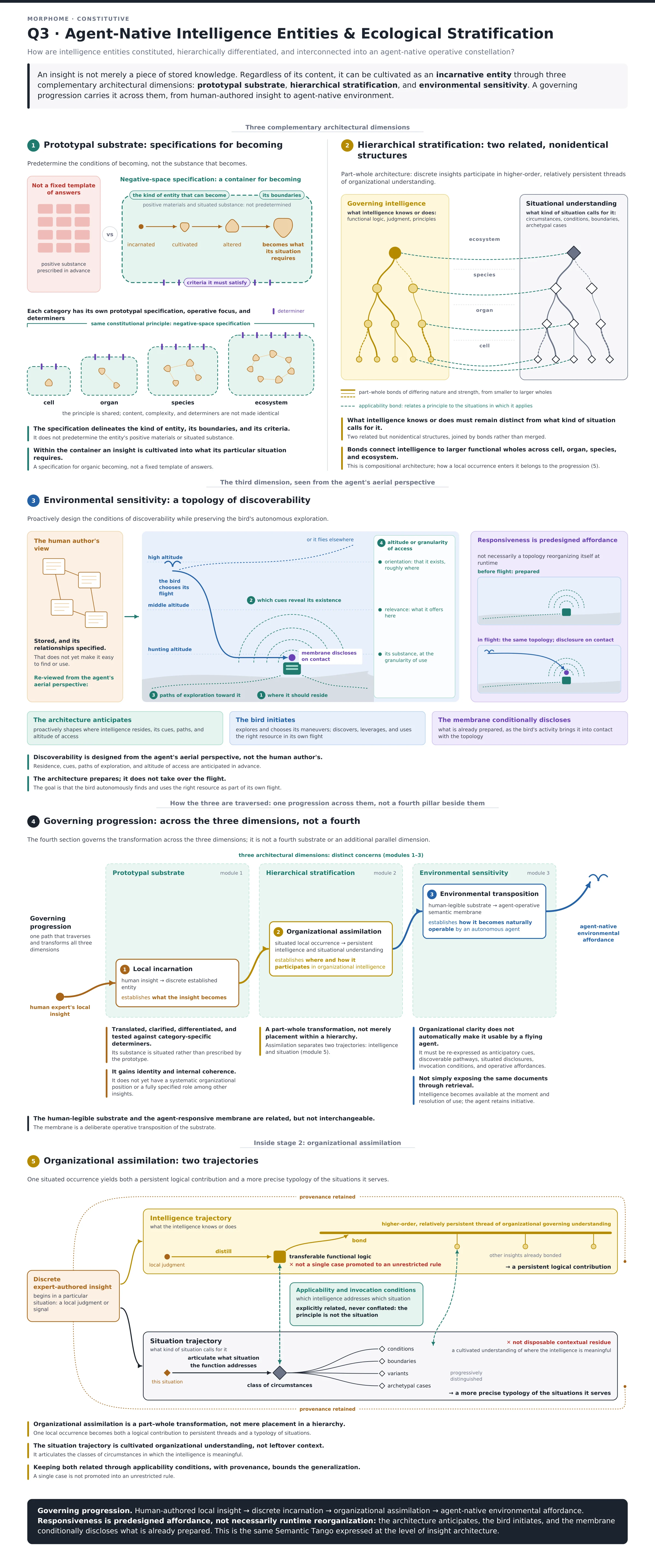
MORPHOME · CONSTITUTIVE Q3 · Agent-Native Intelligence Entities & Ecological Stratification How are intelligence entities constituted, hierarchically differentiated, and interconnected into an agent-native operative constellation? An insight is not merely a piece of stored knowledge. Regardless of its content, it can be cultivated as an incarnative entity through three complementary architectural dimensions: prototypal substrate, hierarchical stratification, and environmental sensitivity. A governing progression carries it across them, from human-authored insight to agent-native environment. Three complementary architectural dimensions 1 Prototypal substrate: specifications for becoming Predetermine the conditions of becoming, not the substance that becomes. Not a fixed template of answers positive substance prescribed in advance vs Negative-space specification: a container for becoming the kind of entity that can become its boundaries criteria it must satisfy incarnated cultivated altered becomes what its situation requires positive materials and situated substance: not predetermined Each category has its own prototypal specification, operative focus, and determiners determiner same constitutional principle: negative-space specification cell organ species ecosystem the principle is shared; content, complexity, and determiners are not made identical The specification delineates the kind of entity, its boundaries, and its criteria. It does not predetermine the entity's positive materials or situated substance. Within the container an insight is cultivated into what its particular situation requires. A specification for organic becoming, not a fixed template of answers. 2 Hierarchical stratification: two related, nonidentical structures Part–whole architecture: discrete insights participate in higher-order, relatively persistent threads of organizational understanding. Governing intelligence what intelligence knows or does: functional logic, judgment, principles Situational understanding what kind of situation calls for it: circumstances, conditions, boundaries, archetypal cases ecosystem species organ cell part–whole bonds of differing nature and strength, from smaller to larger wholes applicability bond: relates a principle to the situations in which it applies What intelligence knows or does must remain distinct from what kind of situation calls for it. Two related but nonidentical structures, joined by bonds rather than merged. Bonds connect intelligence to larger functional wholes across cell, organ, species, and ecosystem. This is compositional architecture; how a local occurrence enters it belongs to the progression (5). The third dimension, seen from the agent's aerial perspective 3 Environmental sensitivity: a topology of discoverability Proactively design the conditions of discoverability while preserving the bird's autonomous exploration. The human author's view Stored, and its relationships specified. That does not yet make it easy to find or use. Re-viewed from the agent's aerial perspective: high altitude middle altitude hunting altitude 4 altitude or granularity of access orientation: that it exists, roughly where relevance: what it offers here its substance, at the granularity of use 1 where it should reside 2 which cues reveal its existence 3 paths of exploration toward it or it flies elsewhere the bird chooses its flight membrane discloses on contact Responsiveness is predesigned affordance not necessarily a topology reorganizing itself at runtime before flight: prepared in flight: the same topology; disclosure on contact The architecture anticipates proactively shapes where intelligence resides, its cues, paths, and altitude of access The bird initiates explores and chooses its maneuvers; discovers, leverages, and uses the right resource in its own flight The membrane conditionally discloses what is already prepared, as the bird's activity brings it into contact with the topology Discoverability is designed from the agent's aerial perspective, not the human author's. Residence, cues, paths of exploration, and altitude of access are anticipated in advance. The architecture prepares; it does not take over the flight. The goal is that the bird autonomously finds and uses the right resource as part of its own flight. How the three are traversed: one progression across them, not a fourth pillar beside them 4 Governing progression: across the three dimensions, not a fourth The fourth section governs the transformation across the three dimensions; it is not a fourth substrate or an additional parallel dimension. three architectural dimensions: distinct concerns (modules 1–3) Prototypal substrate module 1 Hierarchical stratification module 2 Environmental sensitivity module 3 1 Local incarnation human insight →discrete established entity establishes what the insight becomes 2 Organizational assimilation situated local occurrence →persistent intelligence and situational understanding establishes where and how it participates in organizational intelligence 3 Environmental transposition human-legible substrate →agent-operative semantic membrane establishes how it becomes naturally operable by an autonomous agent human expert's local insight Governing progression one path that traverses and transforms all three dimensions agent-native environmental affordance Translated, clarified, differentiated, and tested against category-specific determiners. Its substance is situated rather than prescribed by the prototype. It gains identity and internal coherence. It does not yet have a systematic organizational position or a fully specified role among other insights. A part–whole transformation, not merely placement within a hierarchy. Assimilation separates two trajectories: intelligence and situation (module 5). Organizational clarity does not automatically make it usable by a flying agent. It must be re-expressed as anticipatory cues, discoverable pathways, situated disclosures, invocation conditions, and operative affordances. Not simply exposing the same documents through retrieval. Intelligence becomes available at the moment and resolution of use; the agent retains initiative. The human-legible substrate and the agent-responsive membrane are related, but not interchangeable. The membrane is a deliberate operative transposition of the substrate. Inside stage 2: organizational assimilation 5 Organizational assimilation: two trajectories One situated occurrence yields both a persistent logical contribution and a more precise typology of the situations it serves. provenance retained provenance retained Discrete expert-authored insight begins in a particular situation: a local judgment or signal Intelligence trajectory what the intelligence knows or does higher-order, relatively persistent thread of organizational governing understanding other insights already bonded local judgment distill transferable functional logic bond →a persistent logical contribution Situation trajectory what kind of situation calls for it this situation articulate what situation the function addresses class of circumstances conditions boundaries variants archetypal cases progressively distinguished →a more precise typology of the situations it serves ✕not disposable contextual residue a cultivated understanding of where the intelligence is meaningful Applicability and invocation conditions which intelligence addresses which situation explicitly related, never conflated: the principle is not the situation ✕not a single case promoted to an unrestricted rule Organizational assimilation is a part–whole transformation, not mere placement in a hierarchy. One local occurrence becomes both a logical contribution to persistent threads and a typology of situations. The situation trajectory is cultivated organizational understanding, not leftover context. It articulates the classes of circumstances in which the intelligence is meaningful. Keeping both related through applicability conditions, with provenance, bounds the generalization. A single case is not promoted into an unrestricted rule. Governing progression. Human-authored local insight →discrete incarnation →organizational assimilation →agent-native environmental affordance. Responsiveness is predesigned affordance, not necessarily runtime reorganization: the architecture anticipates, the bird initiates, and the membrane conditionally discloses what is already prepared. This is the same Semantic Tango expressed at the level of insight architecture.